Microsoft AlumniHERO Award · 2019
Alums act locally and think globally to Humanize Homelessness
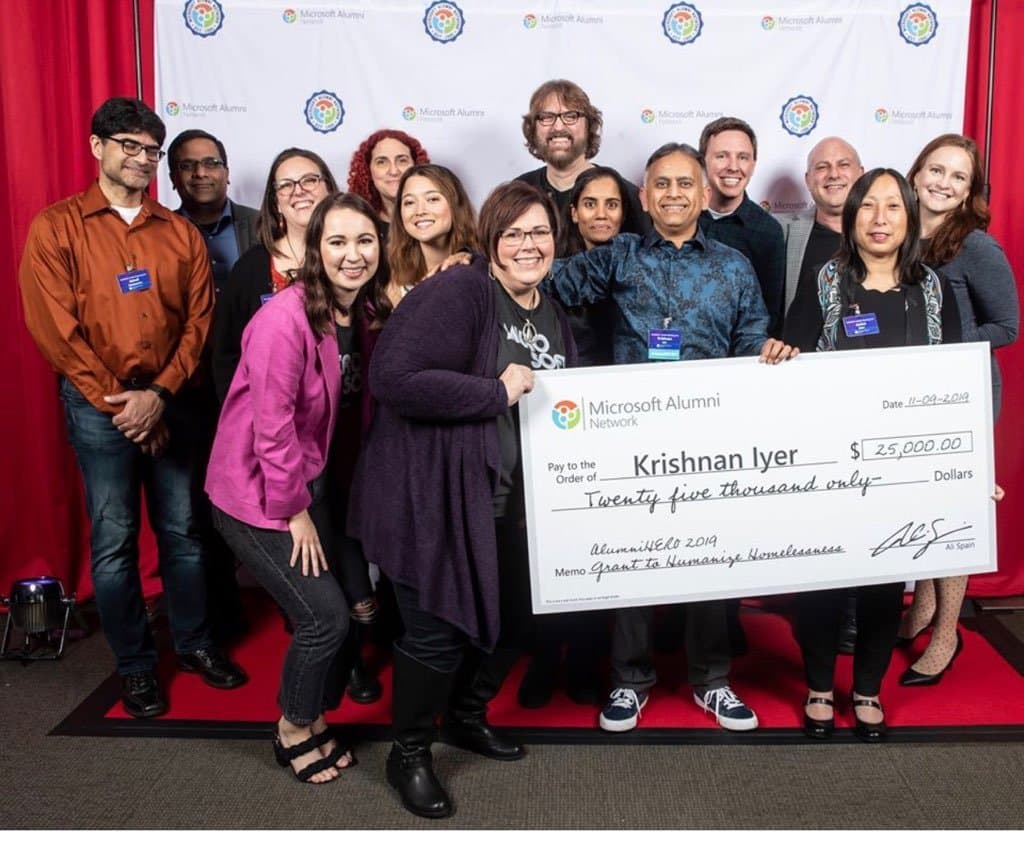
AlumniHERO award winners Krishnan Iyer, Jayant Swamy, Shesh Mathur and John Coates team to tackle the homelessness issue.
By Becky Monk · Microsoft Alumni Network
When Paul Shoemaker wrote his book "Can't Not Do" about finding your purpose and tackling big hairy problems in the world, Krishnan Iyer was at the book launch and he was inspired by his fellow Microsoft alumnus.
"I was telling Paul, 'I don't have my Can't Not Do.' So, he actually wrote it on my book, 'I hope you find your Can't Not Do,'" he said. "So, I took that book, and I had it, and I didn't find it right away. So, I was always like, 'What is my Can't Not Do?'"
Turns out that passion project for Krishnan is Humanize Homelessness, his nonprofit organization that aims to make it easy to help people experiencing homelessness. Krishnan rallied other Microsoft alumni, including Jayant Swamy, Shesh Mathur and John Coates, and members of his community network to tackle a few small pieces of a very big problem in the greater Seattle area.
Around half a million Americans are estimated to be experiencing homelessness. King County, with approximately 11,643 homeless individuals, has the third largest homeless population, trailing only Los Angeles County and New York City. He's making sure that as they build the nonprofit they're using some of the big lessons they learned during their time at Microsoft — build on your super powers, know your customers, work with partners, make it scalable.
For Krishnan, finding his "Can't Not Do" coincided with an Indian Hindu temple being defaced with hate graffiti and language. The anti-immigrant sentiment in the U.S. was gaining a louder voice.
"We have been very blessed to live in this place... I felt like we have a responsibility to give back, because we've taken a lot. The person who wrote that on the temple wall obviously didn't see us helping. He didn't see us as being part of the mainstream community, helping local problems. So, I felt like we have to do something about that."
He started visiting homeless shelters in the community and asking what he could do to help. Skeptical shelter leaders, who get offers from well-intentioned people all the time, told him to come back around Thanksgiving and provide food. Then he rallied friends in his Microsoft alumni network and the Indian community at large to help.
"Maybe about two-thirds said yes, and then half actually came. And then a quarter actually stayed," Krishnan recalls. Fellow Microsoft alum Jayant Swamy was among them. He signed on to help launch Bellevue, Washington-based Humanize Homelessness and is now a Humanize Ambassador.
They hosted happy hours with shelter leaders to learn about the gaps and needs. Those learning sessions set up the basics for the programs Humanize Homelessness would deliver — and became the basis for the name and the language they use to describe the mission.
"We should never label people. When you call somebody 'homeless,' it sticks... the right term is people experiencing homelessness, because we want it to be a temporary situation, so they can get out of it."
The "humanize" part of the nonprofit's name refers to the community at large. "We want the humanity that's in all of us, the compassion that we already have inside... we want it to be opened up," Krishnan said. "That means that when you see a person, then you can understand them, and not judge them."
Program 1: Know Your Neighbor
"It's not just about going to the soup kitchen and serving food, because that sets up a power dynamic — 'I'm the provider, you're the receiver.' We want to change that dynamic," Krishnan said. "One of the new things we're introducing is that you sit down and share your food with them. It's just like a block party with your neighbors or friends — you get together and eat food together, because that's a different dynamic."
Krishnan and the team used Diwali, the Hindu festival of lights, as "the on-ramp" for the Indian community to reach beyond its own circle. Seniors made care packages with lights, socks, lip balm and other necessities, then took the Diwali celebration — food and lights — into three different shelters and celebrated with 150 people experiencing homelessness. They did something similar with the Jewish Cultural and Community Center, celebrating Purim with a rabbi on hand to explain the holiday.
Out of this came a replicable, scalable model. "We give them all the necessary tools so they can go recruit five of their friends. Then we find a shelter for them to go do Know Your Neighbor — whether you bring five or 20 people, or want a 150-person celebration."
Program 2: Back on Your Feet
The next program identifies ways to help those experiencing homelessness get off the streets and out of the shelters. "That's a very complex problem, and we're just starting to scratch the surface," he said. "We have a program called Back on Your Feet to build services or fill the gaps between employers who want to hire and shelters who want to have qualified people experiencing homelessness get back on their feet." In some cases that means providing rides to interviews, helping with resumes, building LinkedIn profiles, and providing introductions.
Program 3: Champions
The third program works with what Krishnan calls Champions — business, political and community leaders who can help with funding and moving mountains. "We bring together superpowers. That, to me, is very similar to open-source. Instead of open-source software, we're being open-source philanthropy."
Other covenants he brought from Microsoft include "know your customer" (the shelters they work with), constantly learning to deliver better programs, building reliable minimum viable products, and scaling them. He's already been contacted by people in other cities who want to replicate the model: "Find champions, work with shelters, connect with your lawmakers, get businesses to contribute. Get to critical mass and help. We can franchise it — take this model, you can have it anywhere in the world."
While that's the goal, Humanize Homelessness is just ramping up. Krishnan said winning the Microsoft Alumni Network's 2019 AlumniHERO award and grant was the first major outside funding the organization received — and he put much thought into how to maximize what it could do to help meet the nonprofit's needs in its infancy.
Originally published by the Microsoft Alumni Network · Written by Becky Monk. Reproduced here with the original article on microsoftalumni.com (requires Microsoft Alumni Network membership to view).